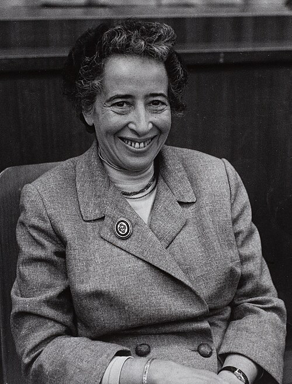
Hannah Arendt
1906 - 1975
Arendt is one of the most undervalued thinkers of the twentieth century. And yet, many of her reflections on “totalitarianism”, the “human condition”, “revolution” as well as “evil” have become philosophical commonplaces. To me, one of her most brilliant insights into the nature of totalitarianism is that the flip side of the (utopian) belief that “everything is possible” is “that everything can be destroyed”. Her view on violence as a political means echo Kant: “the practice of violence … changes the world, but the most probably change is to a more violent world”. Her views on revolution are not uncontroversial: she famously favours the American revolution over the French (and Russian) ones, because only the former did “found” freedom by focussing on the “political question”, whereas the latter’s focus on the “social question” ultimately leads, she thinks, to Jacobine terror. Her idea of a federal republic of councils, as a republic of republics in which active citizens exercise power has up to today largely remained underexplored by contemporary political theory. For those interested in Arendt’s political philosophy, a wonderful overview can be found here.

Ronald Dworkin
1931 - 2013
When I was a student, my favourite legal philosopher was Dworkin because his early jurisprudential work explored the meaning of “law” and “justice” not in systemic and philosophical macro-terms but through a micro-theory that concentrated on “courts” and “judges”. That recentred legal philosophy in a dual way: it shifted it towards legal “reality” (law is ultimately what courts interpret it to be) and the contemporary “present”, as a judge must decides a concrete problem of “today”. According to Dworkin, the judge thereby acts as a critic and artist at once: he must critically interpret all pre-existing legal materials and, if need be, find “new” legal solutions consistent with the past. The famous metaphor that Dworkin here offered is that of the “chain-novel”, where each judge is asked to write a new chapter (or verse, in Whitman’s famous poem) that respects the overall integrity of the chapters that had been written before. Law as integrity or law as interpretation does not mean stasis; nor, of course, revolution. It means building the future on the past, while critiquing it immanently, so to distil the best moral principles from it. I still believe that this is a beautiful way to think about the task of adjudication, but my views on Dworkin as a legal philosopher have, ever since he abandoned his micro-theoretical approach changed; and once I read Brian Leitner ’s critical engagement with him, I cannot take Dworkin all too seriously.
Immanuel Kant
1724 - 1804
Of all the persons selected here, Kant is the only one whose life did not fall into the twentieth century. In fact, he is an eighteenth-century philosopher whose thoughts nonetheless have an enormous influence today. A first major Kantian revival took place at the end of the nineteenth century (Neo-Kantianism I), while the twentieth century uptake of Kant by, in particular, Rawls and Habermas (Neo-Kantianism II), gave him a contemporary relevance that few enlightenment philosophers have today. Kant is mainly known for his transcendental epistemology but his work as a moral philosopher is as important. He wrote little on “law” as such (and when his “Legal Theory” was published in 1797, many believed this work to be the late product of a senile mind). His essay on perpetual peace has however generally fared better; even if his key idea of a “federation of peoples”, as the solution to perpetual peace, did significantly change over time. Today, some Neo-Kantians reject the quest for a metaphysical dimension, others – like Benhabib – have insisted on the need for a metaphysical re-founding of especially international law. In the early 2010s, I worked on Neo-Kantian thought in international law with Katrin Flikschuh but after two years decided to work, instead, on the various conceptions of international normativity in the long nineteenth century.