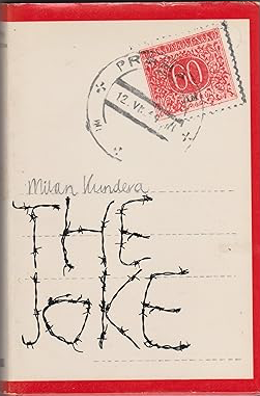
The Joke
1967 (Milan Kundera)
Instead of a third legal choice, this is a non-scientific book altogether: Milan Kundera’s “The Joke”. For anyone interested in what was immoral with “real-existing” socialism, this book is a good start. It tells the story of a young student who flippantly responds to a private letter praising the optimism of socialism with an (equally private) postcard that reads: “Optimism is the opium of mankind!”. While clearly meant as a joke, the protagonist still loses everything: he is expelled from the party as well as his university (in socialism you had, of course, to prove your ideological “worth” to go to university); and he is, at least for a while, treated as a criminal outcast. To me the book portrays the all-pervasive, petty-minded and often intolerant character of party socialism in the 1960s, where the false certainties of public doctrine led many to escape into “private” life (and Kundera’s protagonists usually have a lot of it). This was Kundera’s first novel, fairly autobiographical and already full of his “perspectivism”. It was banned in his home country in 1968 after Soviet tanks crushed the Prague Spring. My father would almost have been part of the Warsaw Pact forces …
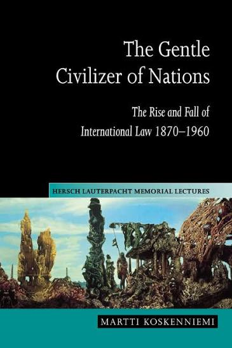
The Gentle Civilizer of Nations
2001 (Marrti Koskenniemi)
After I joined Durham, Colin Warbrick – the then chair of international law there – told me, when asked for recent literature, that there were really only three things worth reading, among which he listed Koskenniemi’s “From Apology to Utopia”. Of course, I immediately bought the book as well as Koskenniemi’s second book “The Gentle Civilizer of Nations: The Rise and Fall of International Law, 1870-1960” – which would become the book I must have read more times than any other legal book. For the “Gentle Civiliser” remains to me a source of immense inspiration and frustration in equal measure. Being only the second major English-language monograph on the history of international law, the book is a treasure of learning (and footnotes) and rightly became the go-to-book for anyone interested in the history of international law. Yet Koskenniemi’s zermalmender narrative style and the book’s core argument that “modern” international law only emerged around 1873 have become a major source of frustration (to me). On a broader historical level, Koskenniemi’s thesis directly clashes, without ever acknowledging it, with Kosselleck’s saddle-time argument (which I happen to believe in) and which, following my own analysis of the earlier nineteenth-century legal discourses proves rather convincing. Finally, Koskenniemi’s intellectual portrait of Lauterpacht as a “natural lawyer” turned American (legal) “realist” is, in my view, simply indefensible.
The Changing Structure of International Law
1964 (Wolfgang Friedmann)
Having fled Nazi Germany in 1934, first for Great Britain and later for the United States, Friedmann taught for most of his life at Columbia University in New York. When I first read his “The Changing Structure of International Law” during my doctoral studies, I was so impressed that I decided to use its title as the subtitle for my own first book (replacing international with European law, of course). The book posits that a shift from a “law of coexistence” to a “law of cooperation” has taken place in the international sphere after 1945; and that this conceptual shift had impacted all core doctrines of international law. For European law something similar takes place through the shift from dual to cooperative federalism, because the core constitutional principles of dual federalism (enumeration, exclusivity, co-existence) are different from those of cooperative federalism (subsidiarity, pre-emption, cooperation). Friedmann’s international law work has, in the past decades, regained some limited interest mainly through Koskenniemi’s “Gentle Civilizer of Nations”, which contrasts Friedmann’s (European) culture of formalism with American (international) realism.