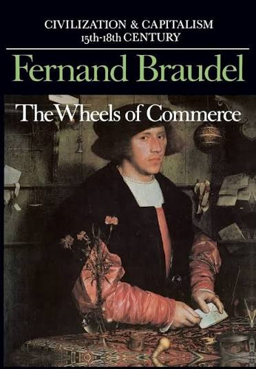
Fernand Braudel
1902 - 1985
All three historians mentioned here are “theorists” of history, with Braudel, at first, the least explicit about it. A member of the French Annales School, Braudel first came to fame with a celebrated study of the “Mediterranean”. In it, three levels of time are distinguished so as to explore the very nature of time as a phenomenon moving at different speeds: long time (longue durée), as the almost imperceptible history of the environment, medium time, as the time of states or economic systems; and short time (event history) as it is perceived by contemporaries. This approach was later extended to an analysis of capitalism, and the ultimate result was his three-volume study on “Civilization and Capitalism, 15th – 18th Century”. Braudel here distinguishes three forms of material live that are not only linked to his three time-structures but also to the three material functions of consumption, distribution and production. The third volume “The Perspective of the World” (in French: “Le Temps du Monde”) was heavily influenced by Immanual Wallerstein whose “The Modern World System” had started to appear in 1974. Outside France, Braudel is today largely forgotten – though the European University Institute continues to honour him in the form of a fellowship programme to this day.
Reinhard Koselleck
1923 - 2006
Among the three historians, Koselleck was undoubtedly the most theoretically minded. From his doctoral and habilitation thesis onwards, and especially through his involvement in the “Geschichtliche Grundbegriffe”, Koselleck believed in the need for “theory” when it came to interpreting history. With that ambition, he developed a number of core ideas that have become extremely influential. The most important here is probably the idea of a “saddle time”, as the period between 1750 and 1850 in which all the main concepts of political and social life are transformed from their “old” into our “modern” meaning. With this radical idea, Koselleck moved the era of “modernity” from “1500” to around “1800”; and he famously tried to demonstrate the transformation from “old” to “new” meaning through the concept of “history” itself (though, for a lawyer, more important examples are: “constitution” and “democracy”). The second important theoretical innovation that Koselleck made is his insight that the relation between “experience” and “expectation” fundamentally changes in modern times – a theme that is later on sociologically explored by Hartmut Rosa. For those interested, Koselleck’s project has, especially more recently, been subject to important studies.
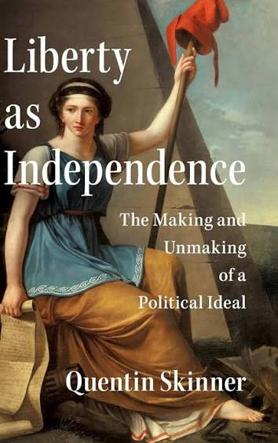
Quentin Skinner
1940 -
In 1969, a fifty-pages article appeared in “History and Theory” under the title “Meaning and Understanding in the History of Ideas” in which a young Cambridge lecturer defended the discipline of intellectual history against its critics. According to Skinner, we can’t just read “texts” as if they embodied an eternal meaning: each text had an historical author; and each author had a concrete problem that her text wanted to act towards. The two classic interpretative methodologies of “textualism” and “contextualism” are thus discarded: the former over-emphasises the “permanent” (the text), whereas the latter exaggerates the “transient” historical factors (the context). For the social context never “determines” a text; it can only ever offer “a sort of court of appeal” in assessing what a text could mean, but the author remains free to “do” something different with the normative vocabulary available at her time. This “speech act” theory would be the basis of the “Cambridge School”; and Skinner has himself made brilliant use of this approach in works on “Hobbes” and “liberty”. During my first academic sabbatical, I audited Skinner’s special seminar on “Hobbes”; and his battle cry of “less philosophy, more history” has been with me ever since.