Articles

Koskenniemi’s Lauterpacht: A “Gentle Civilizer”?
in (2025) 36 European Journal of International Law (forthcoming)
Abstract: Lauterpacht’s normative project has been subject to a number of excellent studies in the past,
most notably by Martti Koskenniemi. The central image of the latter’s ‘Lauterpacht’ is,
famously, that of a backward-looking thinker: Lauterpacht is portrayed as a
‘natural lawyer’
who nostalgically looks back into the nineteenth century, as the last representative of a
‘Victorian tradition’ in international law. This article wishes to critique and challenge this
influential intellectual portrait. In order to do this, it revisits Lauterpacht’s rich academic
oeuvre in three sections. Section 2 begins with a reconstruction of Lauterpacht’s understanding
of the judicial function – a function on which much of Koskenniemi’s Lauterpacht hinges.
Section 3 explores the legislative function within Lauterpacht’s international legal order, while
Section 4, subsequently, investigates the ‘function’ given to natural law in Lauterpacht’s
normative project. Section 5, finally, offers a critical challenge to Koskenniemi’s ‘Lauterpacht’
and re-evaluates the place he should be given within the history of twentieth-century
international law. A Conclusion contends that Lauterpacht is best characterised as a utopian
international federalist, whose supranational legacy has largely remained unredeemed.
‘Victorian’ Traditions: British International Law Scholarship, 1830-1914
in (2025) 74 International and Comparative Law Quarterly, 409-435
Abstract: What are the philosophical and normative orientations of British international law
scholarship during the Victorian era? This article explores and answers this question in
three complementary steps. It begins with an analysis of the ‘public’ international law
textbooks after 1830 to show that, instead of a single legal tradition, there coexisted three
competing traditions during this period: a ‘naturalist’, an ‘historicist’ and a ‘voluntarist’
tradition. These three Victorian traditions will, in a second step, be studied in the context
of ‘private’ international law—a discipline that developed and received its name during this
period. A third section finally offers a detailed examination of the transformative work
of Lassa Oppenheim, which straddled the Victorian nineteenth century and the ‘modern’
twentieth century. In revisiting the normative project(s) of Victorian international law, the
article hopes to critique three prominent views in the contemporary academic literature.
The first view holds that voluntarist State positivism exercised a dominant influence on
British international law scholarship after 1830; a second view has claimed, relatedly, that
during this period an idiosyncratic ‘English’ approach to international law emerged; and
a third view has famously suggested that there was a ‘radical’ break in the discipline of
international law around 1870.
Integration-through-Law: Grand Theory, Revisionist History
in (2025) 4 European Law Open, 162-200
Abstract: How has the European Union been integrated in the past? Legal academics have traditionally pointed to the
Court of Justice and to the broader idea of an‘integration-through-law’. Through its supranational
jurisprudence, the Court– not the EU legislature– was thus placed at the centre of the European integration
project. The underlying reasons for this dominance of constitutional‘law’ over legislative‘politics’ have
thereby been the subject of three famous explanations: the‘equilibrium theory’ (Weiler), the‘asymmetry
theory’ (Scharpf) and the‘over-constitutionalisation theory’ (Grimm). What are the merits of these grand
theories of European integration when measured against the historical record? This article hopes to explore
this question in the context of the internal market. Its historical revision begins with an analysis of the
respective spheres of normative and decisional supranationalism during and after a foundational period
(Sections 2 and 3). This is followed by an examination of the meaning and significance of the Cassis de Dijon
judgment in the late 1970s. Through this revolutionary case, a dialectical relationship between the EU Court
(‘law’) and the EU legislator (‘politics’) emerges (Section 4) that ultimately leads to the spectacular rise of EU
legislation (Section 5) after the SEA. This transformational relationship will provide the critical lens for a
historical revaluation of the three grand theories of legal integration (Section 6).
British Utilitarianism after Bentham: Nineteenth-Century Foundations of International Law II
in (2024) 26 Journal of the History of International Law, 243-284
Abstract: What are the legal principles of British utilitarianism in the long nineteenth century;
and what conception(s) of international law do they offer? The celebrated founder of
the utilitarian school is Jeremy Bentham, who categorically rejects all metaphysical
natural law thinking by insisting that all positive law ought to be adopted by a legislature. But in the absence of a world legislature, what did this mean for the positivity and
normativity of international law? Surprisingly, Bentham and a second generation of
utilitarian thinkers can affirm the legally binding nature of international law; yet with
John Austin, a radical ‘sovereigntist’ critique subsequently casts doubt over the nature
of international law as law ‘properly so called’. This infamous scepticism would have a
profound impact on British international thought in the twentieth century; yet in
the nineteenth century, the ideas of a third-generation utilitarian became more prominent: the liberal philosophy of John Stuart Mill. Mill’s ‘relativist’ and ‘civilisational’
conception of international law thereby gave the utilitarian project a specifically
imperialist dimension that will be analysed, both in its utilitarian-philosophical
and practical-legal dimensions. The article, however also explores two other legacies
of British utilitarianism, namely: the rise of international codification and the emergence of a specifically British conception of private international law during the nineteenth century.
German Idealism after Kant: Nineteenth Century Foundations of International Law
in (2023) 25 Journal of the History of International Law, 105-141
Abstract: What are the legal principles of German idealism in the long nineteenth century; and
what conception(s) of international law do they offer? Opposing Kantian rationalism
and its formalist law, two idealist reactions do emerge in the early decades of the nineteenth century. The first is offered by Hegel whose conception of state law will make
him the principal representative of the future deniers of an objective international law.
The second reaction comes from the German Historical School, whose moral and legal
understanding of the people(s) does – on the contrary – develop a positive conception
of international law based on a ‘society’ of nations. How, and to what extent, were
these two idealistic approaches reflected in the international law textbooks of the age?
This article investigates this question and finds that it is unquestionably the Historical
School that came to dominate international law thinking in the long nineteenth century – and that not just in Germany but also in Italy and Great Britain. The nineteenth
century is thus decidedly, under the influence of Savigny and the Historical School, a
metaphysical century centred on an intrinsic connection between morality and law.
Demoicracy in Europe: Some Preliminary Thoughts
in (2022) 47 European Law Review, 24-51
Abstract: What does the neologism demoicracy mean? If democracy is the “government” of the “people”, can
there be a government of peoples? Are international organisations, like the United Nations,
demoicracies; or should the United Kingdom, as a multi-nation state, be viewed as such? Within the last
decade, the idea of demoicracy has developed considerable traction, especially within the political
science literature on the European Union. Yet what exactly is demoicracy supposed to mean in this
context; and what models of demoicracy have developed to explain the “realities” of a plurality of
peoples governing together? This Working Paper aims to explore the theoretical and historical
expressions of the curious concept of demoicracy. Section 1 starts by clarifying two important
philosophical distinctions, namely the difference between popular sovereignty and popular government
and, equally, the distinction between an (international) Union of States and a (national) Union State.
Sections 2 offers a constitutional overview of the potentially demoicratic elements within the United
States of America; while Section 3 analyses and compares the founding and government of the European
Union in demoicratic terms. Section 4 critically presents the three main models of demoicracy that have
developed in the contemporary literature on the European Union, with Section 5 introducing a – new –
fourth model called “republican federalism”. A Conclusion makes a normative argument in favour of
this fourth model from the point of view of the social and legal structure of the European Union.
Britain in the European Union: A Very Short History
in (2022) 13 (Suppl. 2) Global Policy, 39-46
Abstract: From the start, Britain's feelings towards European integration were complex;
and when Britain finally joined the ‘common market’ in 1973, its reasons were
predominantly of an economic nature. Its profound doubts of any ‘federal’ or ‘political’ union would become a recurring theme throughout its membership; and,
in later years, Britain's critical attitude towards transfers of legislative powers to
the European Union found numerous expressions in a wide range of ‘opt- outs’.
They gave the United Kingdom, in the words of the British government, a unique
place within the Union. However, even this halfway house ‘inside’ and ‘outside’
the European Union could not prevent a British referendum in which the majority
of British citizens decided to opt out of Union membership altogether. This article
offers a very short historical overview of British membership in the Union. Six key
moments in the story of British membership will illustrate the complex relationship between Britain and the European Union.
“Re-Constituting” the Internal Market: Towards a Common Law of International Trade?
in (2020) 39 Yearbook of European Law, 250-292
Abstract: Are the trade philosophies behind the EU internal market and the WTO inter-
national market converging or diverging; and are we, or are we not, moving towards a ‘common law of international trade’? Twenty years ago, an interesting—
and swiftly famous—answer to this question was given by Joseph H.H. Weiler.
Studying the ‘constitution of the common market’, the historical evolution of free
movement law is here divided into five periods or generations. The underlying
Weiler thesis is thereby as simple as it is beautiful: starting with an early radical philosophy in Dassonville, the European Union has gradually and consistently moved
away from its original hyper-liberal approach towards an ever more deferential approach; and the transformation of Article 34 TFEU into a discrimination format
ultimately leads to a convergence with international law. What are the empirical
and normative credentials of this stylised construction of the internal market? This
article argues that there are fundamental shortcomings in this standard interpretation of the evolution of the internal market, and that a historical reconstruction
arrives at a very different empirical and normative picture. What can this ‘revisionist’ result mean for EU law scholarship in general? If EU constitutionalism wishes
to ‘re-constitute’ its object of study properly, it needs to abandon the abstract ways
of philosophizing that have become commonplace in the last 25 years. Part and parcel of this methodological renaissance must be a renewed commitment to test (constitutional) theory against (judicial) practice.
"Re‐reading" Dassonville: Meaning and Understanding in the History of European Law
in (2018) 24(6) European Law Journal, 376-407
Abstract: There are a few 'mythical’ judgments that every student of European integration has read or ought to have read. Dassonville is one of these judgments. The Court here makes one of its‘most famous pronouncement[s] ever’; and yet very little historical research on where the Dassonville formula came from and what it was intended to mean in 1974 has yet been undertaken. The conventional wisdom holds that the Court offered a hyper‐liberalist definition of the European internal market, which
radically dissociated itself from the conceptual shackles accepted in modern international trade law. According to this view, Dassonville represents the substantive law equivalent of Van Gend en Loos. This traditional view, it will be argued, is simply not borne out by the historical facts. A contextual interpretation indeed shows a very different meaning of Dassonville; and a closer author‐centric analysis reveals a very different understanding of the Dassonville formula in its historical context.
Judicial Majoritarianism Revisited: “We, the Other Court”?
in (2018) 43(2) European Law Review, 269-280
Reprinted in the 2018 edition of European Current Law
Reprinted in the 2018 edition of European Current Law
Abstract: Twenty years ago, an interesting – and swiftly famous – answer to the legitimacy question in relation to
the judicial creation of the EU internal market was offered by Miguel Poiares Maduro. Heavily
influenced by the “representation-reinforcing theory of judicial review”, developed by J. H. Ely, and
ingeniously entitled “We, the Court”, the book argued that the jurisprudence of the Court of Justice had
been seriously misunderstood when identified with neo-liberal deregulation – a phenomenon that Maduro
associated with the U.S. American idea of “economic due process”. For instead of protecting minority
economic rights against national (democratic) regulation, the European Court showed a “majoritarian
activism”. The judicial review of State legislation by the Court was thus characterised as “a kind of
[Union] legislative process”, in which the Court operates as a quasi-legislature that judicially harmonises
diverse national rules “in accordance with an “ideally drafted” representation of all States’ interest”.
How correct was that description then (and now), and what normative arguments did Maduro propose to
justify – and limit – the idea of “judicial majoritarianism”? This – late – “review” revisits the central
premises of the famous monograph and subjects them – with the benefit of 20 years of hindsight – to
critical scrutiny in the hope of re-opening discussions on the legitimacy of and justice in the internal
market.
From the “Closed” to the “Open” Commercial State: A Very Brief History of International Economic Law
in (2017) 19(4) Revue d'histoire du droit international, 495-524
Abstract: Commerce had become a “reason of state” in the eighteenth century. With the publication of Smith’s Wealth of Nations, the idea that free international trade was economically beneficial however gradually gained prominence. The long nineteenth century
indeed saw timid – bilateral – attempts to implement the new politico- economic philosophy. Yet the First World War and the Great Depression destroyed almost all trade
liberalisation already achieved, and the neo-mercantilist policies of the 1920s and 1930s
seemed to turn the wheels of commerce backwards. Nonetheless, after the Second
World War the belief that a peaceful world order could only be founded on a stable
international economic order emerged strengthened; and a number of institutional
attempts to liberalise – and harness – the world economy were immediately made,
culminating in the creation of the 1947 General Agreement on Tariffs and Trade.
Conclusion: Article 267 TFEU and EU Federalism
in 15 European Journal of Legal Studies, 221-227
Summary: Just some very basic thoughts on judicial federalism in the EU…
Parliamentary Democracy and International Treaties
in (2017) 8(56) Global Policy, 7-13
Abstract: Classic constitutional thought considered the power to conclude international treaties to fall within the executive’s exclusive
domain. But this nineteenth-century logic hardly convinces in the twenty- rst century. For the function of international treaties
has dramatically shifted from the military to the regulatory domain; and in the wake of this‘new internationalism’, the traditional divide between ‘internal’ and ‘external’ affairs has increasingly disappeared. Has this enlarged scope of the treaty power
also triggered a transformation of its nature; and in particular, has the rise of‘legislative’ international treaties been compensated by a greater role accorded to parliaments? This article explores this question comparatively by looking at the constitutional law of the United States and the European Union. Within the United States, international treaties were traditionally
concluded under a procedure that excluded the House of Representatives; yet with the rise of the Congressional-Executive Agreement in the twentieth century, this democratic deficit has been partially remedied. We find a similar evolution within
the context of the European Union, where an increasing‘parliamentarisation’ of the treaty power has taken place. Yet a democratic debate here nevertheless also continues to exist.

Two-and-a-half Ways of Thinking about the European Union
in (2016) 53(3) Politique européenne, 28-37
Abstract: This article argues that the sui generis theory is a ‘negative’ and ‘unhistorical’
theory. It lacks explanatory value for it is based on a conceptual tautology
(Hay, 1966, 37): the European Union is…. what it is; and it is not…. what it is not!
Second, the sui generis theory moreover only views the Union in negative terms
– it is neither international organisation nor Federal State – and thus indirectly
perpetuates the conceptual foundations of the Westphalian tradition. Is there a
better way of thinking about the European Union? This article argues that ‘federal’ thinking provides a rich key to unlocking the nature of the European Union.

Of Types and Tests: Towards a Unitary Doctrinal Framework for Article 34 TFEU?
in (2016) 41(6) European Law Review, 826-842
Abstract: What market model should determine the boundaries of negative integration, and in particular: what test
should the Court apply to Article 34 TFEU? After Keck, there is no single answer to this question.
Having expressly acknowledged the existence of different tests for different types of measures, the post-
Keck Court develops three jurisprudential lines that follow three different market models. While
confining measures regulating selling arrangements to an international model, the Court also confirms the
parameters of the Cassis model for product requirements; and with Italian Trailers, it cultivates a third
jurisprudential line on consumer-use restrictions that comes close to a national market model. It is in the
context of this third line that the Court elevates the market access principle to centre-stage; and it is this
development that has prompted the question how the three jurisprudential lines relate to each other. Have
they remained separate – parallel – lines; or have they converged in a single doctrinal framework that
generally applies to all measures falling within Article 34? In Ker-Optika and its progeny, the Court
appears to rhetorically combine all three lines in an unitary framework; yet various ambivalences within
this doctrinal solution have remained. This article explores the possibilities for a doctrinal framework and
charts the unstable post-Keck jurisprudence on Article 34 TFEU in light of such an unitary
framework.
Tax Barriers to Intra-Union Trade: American ‘Federalism’, European ‘Internationalism’?
in (2016) 35(1) Yearbook of European Law, 382-409
Abstract: The task of creating a ‘common’ market is one of the central tasks of many unions. When the Philadelphia Convention drafted the 1787 US Constitution, there was little argument that the new Union had to become an economic union. And the objective to create a common market lay equally at the heart of the original European Union. This article explores the tension between the idea and practice of ‘parallel’ fiscal sovereignties within a Union and the latter’s aim of creating a common market by exploring the different solutions to this dilemma in the United States and the European Union. While both have indeed shown greater lenience to fiscal barriers (when compared to regulatory barriers), the US constitutional order has come to find a federal solution for fiscal measures under its (dormant) Commerce Clause whereas the European Union has—with one exception—remained loyal to an international solution.

EU Development Policy: Constitutional and Legislative Foundation(s)
in (2013) 15 Cambridge Yearbook of European Legal Studies, 699-718
Summary: The Union’s constitutional regime for development policy has traditionally progressed alongside two parallel tracks. In addition to a general regime for all developing countries, there exists a special regime for African, Caribbean and Pacific Countries (ACP countries). The Union’s development cooperation competence can today be found in Article 209 of the Treaty on the Functioning of the European Union (TFEU) and allows the Union to adopt legislative acts or conclude international agreements to reduce poverty within developing countries. By contrast, the Union’s special development regime has had a very different constitutional source. It stemmed from the ‘colonial’ association to the Union (qua its Member States) of certain dependent ‘oversees countries and territories’ for which the 1957 Treaty of Rome had provided a limited development competence. This article explores the constitutional and legislative bases – historical and contemporary – of the Union’s development policy.
European Fundamental Rights and the Member States: From "Selective" to "Total" Incorporation?
in (2012) 14 Cambridge Yearbook of European Legal Studies, 337-361
Abstract: In parallel with American constitutional thought, there exists a doctrine of incorporation in the European legal order. European fundamental rights will thus not
exclusively limit the European institutions. They may, in certain situations, equally apply to the public authorities of the Member States. This chapter looks
at the incorporation doctrine across the three sources of European fundamental
rights. With three distinct sources of fundamental rights, the constitutional principles governing the European incorporation doctrine are unsurprisingly more
complex than the American incorporation doctrine. What are the similarities and
dissimilarities between the European and the American incorporation doctrine?
The Union presently favours selective over total incorporation. In this respect, it
emulates the American constitutional order. Yet the European doctrine nevertheless differs strikingly from the classic American doctrine. For unlike the latter,
the European legal order has not made incorporation dependent on the type of
fundamental right at issue. The European doctrine has, by contrast, made the
incorporation of Union fundamental rights into national legal orders dependent
on the type of Member State action.
"Delegated Legislation" in the (new) European Union: A Constitutional Analysis
in (2011) 74(5) Modern Law Review, 661-693
Abstract: This article brings classic constitutionalism to an analysis of delegated legislation in the European
Union. To facilitate such a constitutional analysis, it starts with a comparative excursion introducing
the judicial and political safeguards on executive legislation in American constitutionalism. In the
European legal order, similar constitutional safeguards emerged in the last ¢fty years. First, the
Court of Justice developed judicial safeguards in the form of a European non-delegation doctrine.
Second, the European legislator has also insisted on political safeguards within delegated legislation.
Under the Rome Treaty, ‘comitology’ was the de¢ning characteristic of executive legislation. The Lisbon Treaty represents a revolutionary restructuring of the regulatory process. The (old) Community regime for delegated legislation is split into two halves. Article 290 of the Treaty on the Functioning of the European Union (TFEU) henceforth governs delegations of legislative power, while
Article 291 TFEU establishes the constitutional regime for delegations of executive power.
Three "Bills of Rights" for the European Union
in (2011) 30(1) Yearbook of European Law, 131-158
Abstract: The protection of human rights is a central task of modern constitutions. In many constitutional orders, this protective task is transferred to the judiciary and involves the judicial review of governmental action. This protection may be limited to judicial review of the executive. However, in its substantive form it extends to the review of parliamentary legislation; and, where this is the case, human rights set ‘substantive’ limits within which democratic government must take place. The European Union follows this second constitutional tradition. But what are the sources of human rights in the Union legal order? This article investigates the Union's three bills of rights and the constitutional relations between them. Section II starts with the discovery of an ‘unwritten’ bill of rights in the form of general principles of European law. Section III analyses the Union's own ‘written’ bill of rights in the form of its Charter of Fundamental Rights. Section IV investigates the relationship between the Union and the ‘external’ bill of rights in the form of the European Convention on Human Rights.
From Rome to Lisbon: "Executive Federalism" in the (New) European Union
in (2010) 47(5) Common Market Law Review, 1385-1427
Romanian Translation: Da la Roma la Lisbona: “Federalism executiv” in (noua) Uniune Europeană, (2011) Revista Română de Drept European 15-49
Romanian Translation: Da la Roma la Lisbona: “Federalism executiv” in (noua) Uniune Europeană, (2011) Revista Română de Drept European 15-49
Abstract: Is the European Union a legislative giant on clay feet? Is it true that the Union has, with some specific exceptions, no original competence to implement European law? This article analyses the structure of the Union's "executive federalism" in three steps. After a comparative constitutional section on the centralized (American) and decentralized (German) enforcement systems of federal norms, the constitutional foundations of executive power in the European Union are explored. Will Article 291 TFEU provide a reformed textual base for the (new) Union's executive powers? A third section then examines existing constitutional limits to the national (decentralized) and European (centralized) enforcement of European law. An excursus briefly analyses the phenomenon of "mixed administration" through a federal lens. And a conclusion finally argues that the Lisbon Treaty will remedy, to some extent, the lack of clear constitutional foundation of Union executive power.
On "Federal" Ground: The European Union as an (Inter)national Phenomenon
in (2009) 46(4) Common Market Law Review, 1069-1105
Abstract: The emergence of the United States of America in the eighteenth-century triggered a semantic revolution in the federal principle. Federalism became identified with a mixed structure between international and national organisation. However, when this American tradition crossed the Atlantic in the nineteenth century, Europe's obsession with indivisible sovereignty pressed the novel idea into a national format. This article analyses the European Community and European Union in light of the American and European federal tradition. It explores the analytical potential of American federal thought in examining the European Union along three dimensions: a foundational, an institutional and a functional dimension. This inductive approach is contrasted with the deductive approach of European thought. Europe's "statist" tradition insists on the indivisibility of sovereignty. This leads to three constitutional denials: the European Union is said to have no constitution, nor a people (demos), nor a constitutionalism. The very existence of the European Union, often labelled sui generis, has challenged this tradition and, today, European federal thought has gradually come to acknowledge the idea of federalism beyond the State.
'Reforming the "CAP": From "Vertical" to "Horizontal" Harmonization'
in (2009) 28(1) Yearbook of European Law, 337-361
Abstract: I have never understood, why EU constitutional law scholars ignore the Common Agricultural Policy – as the historically most important and most “social” policy of the early European Community! This article explores the “structural” changes in the constitutional allocation of powers that follows from the move from dual to cooperative federalism…
Subsidiarity after Lisbon: Reinforcing the Safeguards of Federalism?
in (2009) 68(3) Cambridge Law Journal, 525-536
Abstract: Despite its literary presence, the principle of subsidiarity has remained a subsidiary principle of European constitutionalism. Why? The reason for its shadowy existence lies in the continued absence of clear conceptual contours. While the principle's ambiguity may have “save[d] Maastricht”, its protean character defied concrete application as a new safeguard against European centralisation. If subsidiarity was everything to everyone, how should the Community institutions apply it? In the light of this failure, various reforms were proposed to strengthen the subsidiarity principle as a “safeguard of federalism”. Two reform options crystallised in the last decade. The first option concentrates on the procedural nature of the principle and attempts to reinforce subsidiarity as a political safeguard of federalism. The second option tries to “substantiate” the principle by strengthening subsidiarity as a judicial safeguard of federalism. In what ways would the Lisbon Treaty – if it enters into force – take up these proposals? This is the question this (short) article will try to answer.
Lisbon and the Federal Order of Competences: A Prospective Analysis
in (2008) 33(5) European Law Review, 709-722
Abstract: The clarification of the European Union's federal order of competences was
one of the principal objectives behind the constitutional reform route leading from Laeken to
Lisbon. After 50 years of incremental growth, principled definitions and a clear division of the
European Union's competences were needed to bring Europe closer to its citizens. The promise of
greater transparency would not be fulfilled by the Lisbon Treaty. On the contrary, if the Treaty ever
came into force, it would represent a step backwards. First, the wording of the European Union's
exclusive competences, especially as regards implied external powers, will imperfectly reflect the
constitutional status quo. Secondly, shared competences have been defined with the vocabulary of
concurrent competences. Thirdly, the re-conception of complementary competences will increase
the instances of "competence cocktails" within policy areas. Finally, the presence of "unofficial"
competence types will erode the European Union's future order of competences.

Dual Federalism Constitutionalised: The Emergence of Exclusive Competences in the EC Legal Order
in (2007) 32(1) European Law Review, 3-28
Abstract: The constitutional philosophy of dual federalism is based on the idea of dual
sovereignty. The federal and the state governments are regarded as co-equals, which operate
independently within their respective spheres. Dual federalism rejects the idea of a hierarchical
relationship between constitutional "levels". In line with that federal philosophy, the constitutional
architecture of dual federalism is based on mutually exclusive powers. The idea of exclusive
powers belonging to the European Community has been a judicial creation. The article revisits the emergence of exclusive competences in the Community legal order. Beyond the Court's "pointillist"
jurisprudence, various attempts have been made to search for broader constitutional guidelines.
These grander constitutional schemes and the two intellectual rationales for constitutional
exclusivity that underpin them will be analysed in turn. The concluding part discusses the
constitutional (pre)conditions that were originally responsible for the emergence of exclusive
powers in the Community legal order.
EC Law and International Agreements of the Member States - An Ambivalent Relationship?
in (2006-07), 9 Cambridge Yearbook of European Legal Studies, 387-440
Abstract: The Community legal order had been declared autonomous in order to establish the supremacy of Community law over national law. But how autonomous was the 'new legal order' vis-a-vis the old legal order of international law? The potential for ambivalence between the European Community and the international legal order was inherent, for the borderline between Community law and international law was 'not so certain or distinct' (Pescatore). The 'complex and ambiguous' relationship with the international legal order in the early days of the Community was particularly troubled with regard to the international powers of the Member States. What was the relationship between the international treaties concluded by Member States and Community law? The internal division of competences between the Community and the Member States did not correspond to the international law perspective that accords external sovereignty to the Member States. This article investigates how the Community legal order has matured in its originally ambivalent relationship with the international treaty-making powers of the Member States. Has this second 'infant disease' been cured?
Co-operative Federalism Constitutionalised: The Emergence of Complementary Competences in the EC legal order
in (2006) 31(2) European Law Review, 167-184
Abstract: Beyond the core areas of European integration, the federal division of
legislative powers between the European Community and the Member States has long been
characterised by a co-operative federalism: national legislators will typically be entitled to
complement the common Community standard. Since the Single European Act, this philosophy
of co-operative federalism has increasingly been "constitutionalised": ever more legislative
competences constitutionally limit the power of the Community legislator to intervene in a
particular policy field. The article traces the emergence of these complementary competences.
It then examines the Community's environmental and public health policies in an attempt to
analyse the constitutional regime governing these complementary competences. The article
concludes that many central constitutional choices are still to be made by the European Court of
Justice, in particular, whether there are hard or soft constitutional limits around the Community's
complementary competences.
Supremacy without Pre-emption? The Very Slowly Emergent Doctrine of Community Pre-emption
in (2006) 43(4) Common Market Law Review, 1023-1048
Abstract:
Legislative competences are potentialities -- entitlements for future legislation -- and only in the rare presence of exclusive European Community power will they pose an immediate and direct limit to national powers. Shared competences will have no such effects. Within shared powers, two legislators are equally competent to adopt legislation. Here, legislative overlaps exist and the potential for conflict arises. Each federal legal order opting for shared competences will, therefore, have to determine when conflicts between two legislative spheres exist and how these conflicts are to be resolved. For the Community's shared powers, these two dimensions have indeed been developed to structure the relationship between European and national legislation. In the EC legal order, the supremacy of Community law has long been established. In the event of a conflict between Community and national law, the former will prevail. This article will investigate the two constitutional principles that structure the Community's shared competences: the twin doctrines of supremacy and pre-emption.
The Morphology of Legislative Power in the European Community: Legal Instruments and Federal Division of Powers
in (2006) 25(1) Yearbook of European Law, 91-151
Abstract: The concept of legislation is central to all modern societies. Legislation refers to the making of laws (legis). ‘But what, after all, is a law? As long as we remain satisfied with attaching purely metaphysical ideas to the word, we shall go on arguing without arriving at an understanding; and when we have defined a law of nature, we shall be no nearer the definition of a law of the State.’ (Rousseau). Which types of laws does the Community have? What is the ‘morphology’ of the European Community’s legislative instruments? How and to what extent do these legislative acts restrict the autonomy of the Member States? Can the Community choose from among its legislative instruments? In order to respond to these questions, we shall first revisit the functional concept of Community legislation before presenting the various perspectives from which the legislative instruments have traditionally been examined. Choosing the federal division of legislative power as our privileged viewpoint, the subsequent sections will investigate the legislative and pre-emptive quality of the various legal acts emanating from the Community.
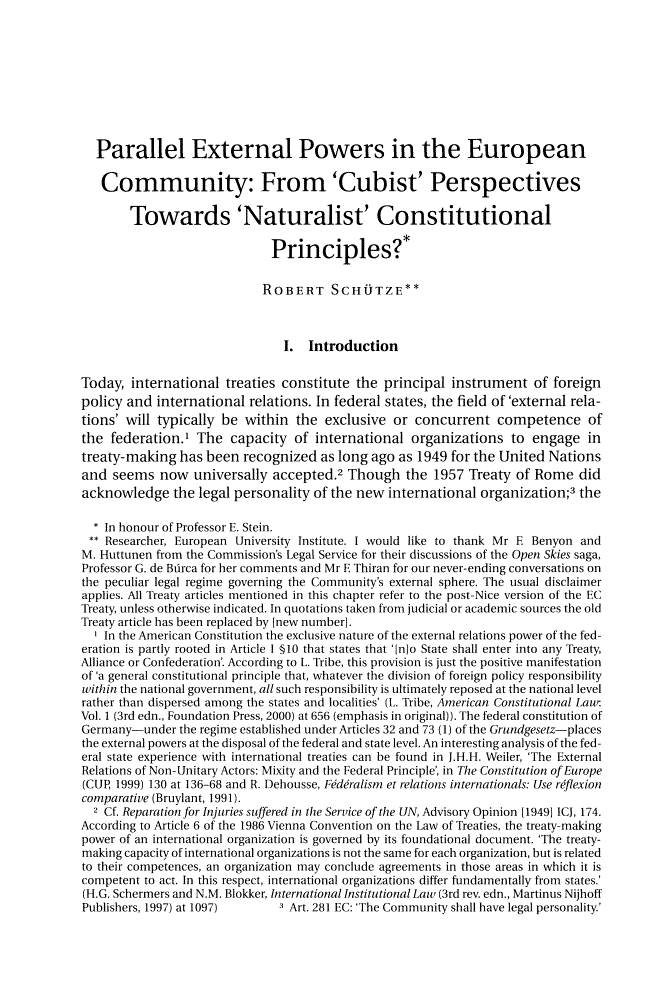
Parallel External Powers in the European Community: From “cubist” perspectives towards “naturalist” constitutional principles?
in (2004) 23(1) Yearbook of European Law, 225-274
Abstract:
In federal states, the field of 'external relations' will typically be within the exclusive or concurrent competence of the federation. Though the 1957 Treaty of Rome did acknowledge the legal personality of the new international organization, the Community's capacity to establish contractual links with third countries did not, however, by itself imply a general external competence for all matters falling within the scope of the Treaty. The Member States had indeed subjected the European Community's external ambitions to a strict enumeration principle. This has radically changed in the last decades, a development explored in this article.
In section II, we shall look at the invention of parallel external powers in the Community legal order and discuss three theories suggested to conceptualize them. Section III will analyse the enigmatic constitutional nature of those parallel powers.

Organized Change towards an ‘Ever Closer Union’: Article 308 EC and the Limits To the Community’s Legislative Competence
in (2003) 22 Yearbook of European Law, 79 -115
Abstract:
In order to pave the way towards an 'ever closer union', the EEC Treaty contained two express provisions laying down the methods and procedures for organized change; and within their respective spheres of application, Articles 235 and 236 EEC were to ensure a continuous process of constitutional adaptation and updating. Article 236 EEC set out the requirements for formal Treaty amendment - now to be found in Article 48 TEU - which could be triggered by following the (more or less) 'normal' international law procedure. The disparity between the 'internationalist' procedure under Article 236 EEC and the relative simplicity of the 'legislative' procedure set out in Article 235 EEC (now Article 352 TFEU) was and remains striking: the adaptation process was left entirely to the Community organs, with the Council ultimately having the final say on the direction, extent, and nature of Community progression into new fields. This article tries to shed some light on the question of the Article's character in the Community's order of legislative competences.
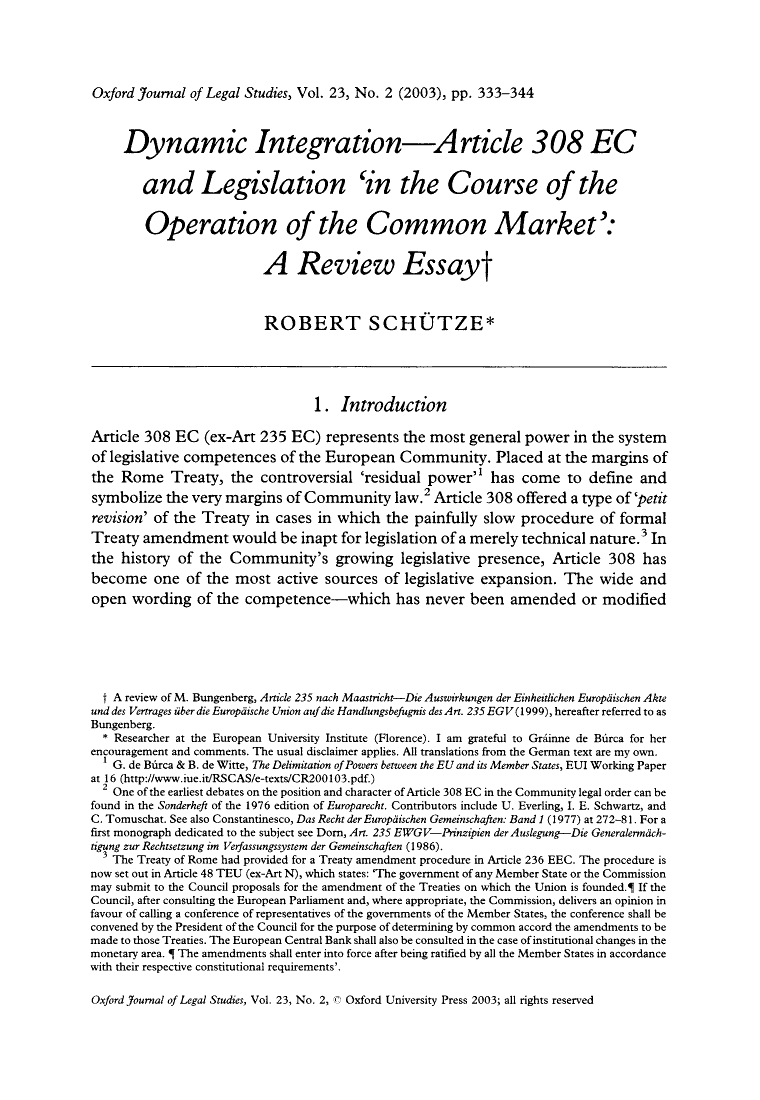
Dynamic Integration – Article 308 and Legislation in the course of the Common Market: A review essay
in (2003) 23 Oxford Journal of Legal Studies, 333-344
Summary: Most PhD students start with a book review…