International Law: Towards “Positive” Normativity, 1789-1989
With the decline of the ideas of universal “empire” and “res publica christiana” in the modern period, the belief in a “global” law was gradually replaced by legal pluralism. The apostles of state sovereignty come to deny the very existence of any (supranational) authority above the State and introduced a distinction that still structures our political imagination today: the distinction between national and international law. The former is the sphere of subordination within a sovereign State; the latter becomes the sphere of coordination between sovereign States. International law is, henceforth, no longer the (global) ius gentium of mankind; it becomes the ius inter gentes that regulates the formal interactions between sovereign states. From this modern perspective an international “civil law” leads to a contradiction: for if sovereignty is the defining characteristic of the modern State, there can be no higher “civil” authority binding states.
For Hobbes (and, following him, Pufendorf), international law therefore cannot be “positive law”; instead, international law is the law of nature applied to nations: “the law of nations properly so called … is nothing else, but the law of nature itself, not applied to men considered simply as such but to nations” (Burlamaqui). What are the normative qualities of this natural law? First and foremost, its verity and authority are guaranteed by God or Nature; and it is, therefore, binding “law”. This law is, secondly, “necessary”; and, as such, eternal and universal: it binds “all Mankind”. Finally, insisting on the sovereign equality of each and every nation, it is – thirdly – decidedly anti-imperialist too.
And yet: one hundred-fifty years later, the “universality” and “anti-imperialism” of this European “natural law” tradition had given way to its very opposite. By the beginning of the twentieth century, the dominant belief within international law was that of a “European family of nations” that was entitled to exclude all non-civilised members from its scope. The older naturalist-universalist conception of international law thus appears to vanish during the nineteenth century; and once the non-European members are expelled, they become lawless “barbarous” nations that can be civilised and colonized according to a (Western) European standard of civilisation.
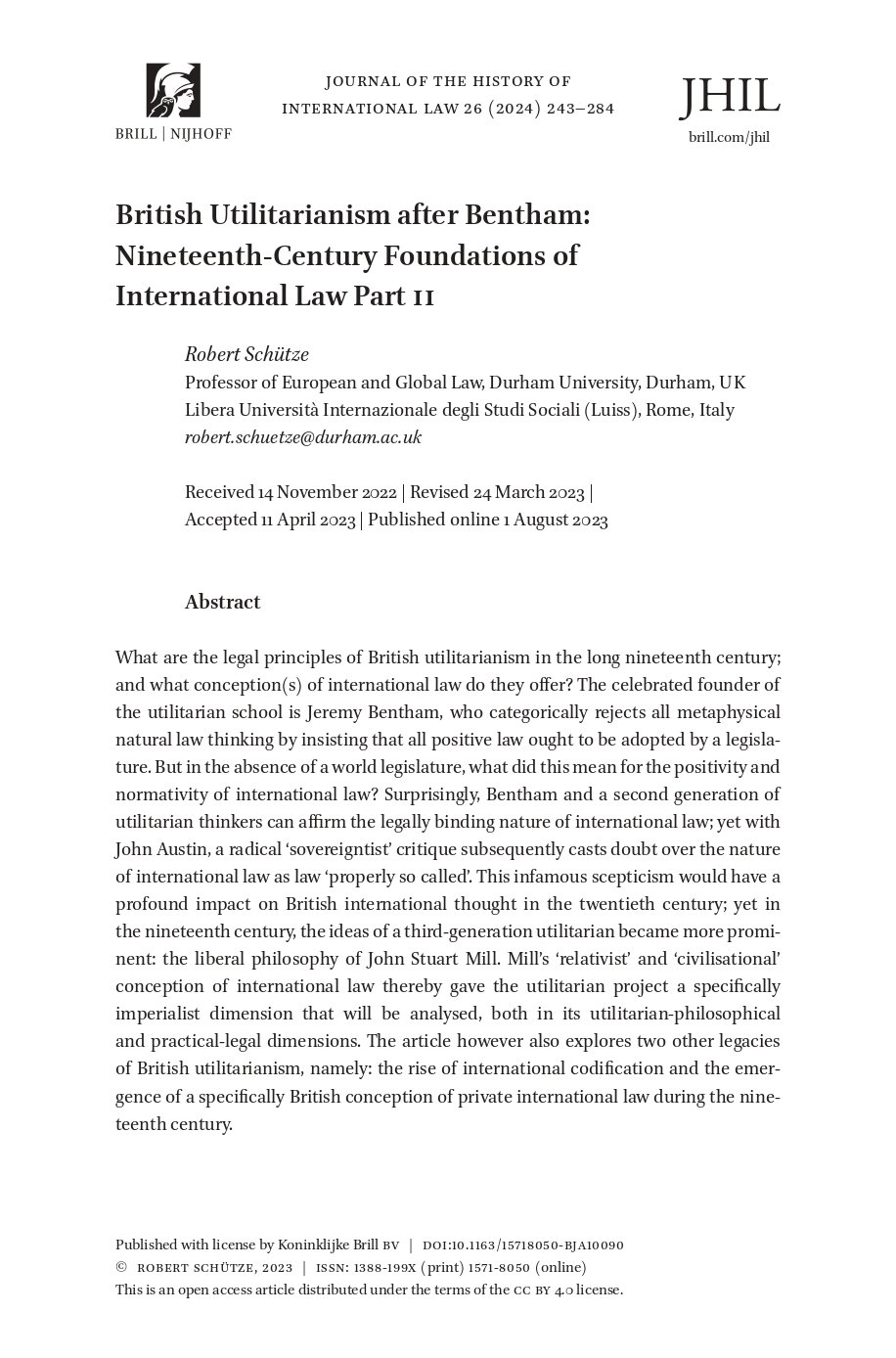
For Charles H. Alexandrowicz this dramatic change in the structure of international law was caused by the rise of a “positivist” philosophy in the nineteenth century. But what does “positivism” here mean? Can Kant, Hegel or Savigny really be identified with the new “positivist” philosophy? Doubts about the “Alexandrowicz thesis” emerged early on. Building on the work of Carl Schmitt, the most radical critique here argued that, within the nineteenth century and “primarily under British influence, international law increased in scope to become universal” (Grewe, 429). The conceptual relation between positivism and the decline of a universal international law has therefore been questioned; and instead, it has more recently been argued, that it was “colonialism” (Anghie) or “capitalism” (Tzouvala) that shaped the exclusionary conception of international law in the nineteenth century.
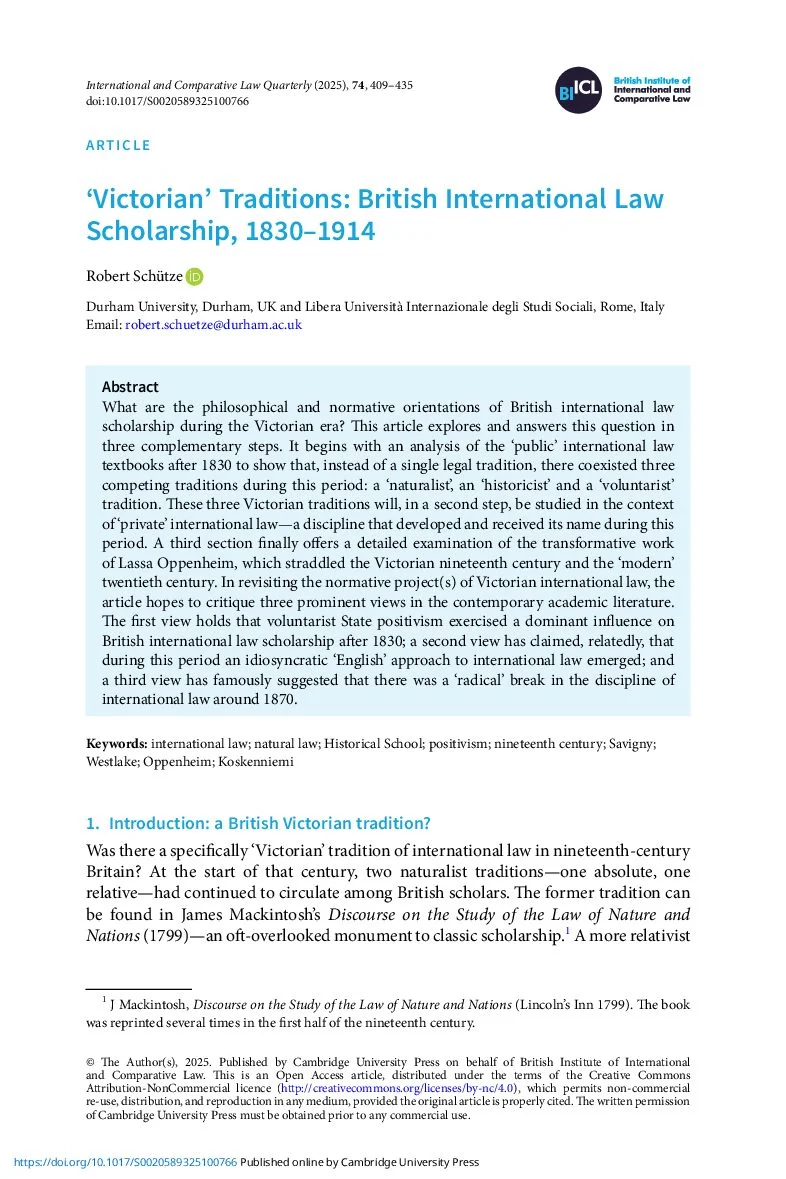
What are we to make of these explanations of the nineteenth-century transformation of international law? And how has the twentieth century developed this conceptual transformation? Has there been continuity between the (Victorian) nineteenth century and the first half of the twentieth – as famously suggested by Marrti Koskenniemi, or not? I have been fascinated by these questions since the early 2010s; and a number of publications have since emerged. My three core hypotheses are here this: (1) it is deeply misleading to characterise the nineteenth century as a “positivist” century – if “positivism” means that there is no essential link between law and morality; (2) the belief that there was a “radical” break in the field of international law, which splits the long nineteenth century into an (unimportant) first half and an important “short” nineteenth century, whose “sensibility” continues into the second half of the twentieth is extremely questionable; and (3) the view that the nineteenth century constitutes the “British age” in which Bentham’s conception of “international law” prevails and in which the older European public law is finally “universalised” is wrong on all fronts.
Some Earlier Publications