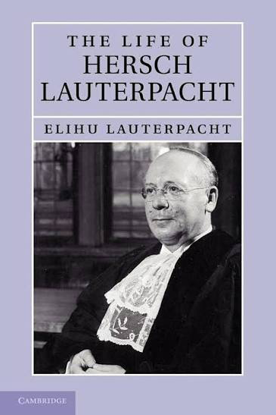
Hersch Lauterpacht
1897 - 1960
There are few legal scholars that have shaped a historical period and fewer still that are remembered for it. Hersch Lauterpacht represents such a rare and magisterial figure, whose thinking has significantly influenced international law in the 20th century and whose works continue to be studied and admired today. Born into the fin-de-siècle Austro-Hungarian Empire, with early studies in Lemberg (now Lviv in Ukraine) and Vienna, Lauterpacht moved to London in the early 1920s. It was in England that he pursued all of his academic career and where he was elected, after a decade working at the London School of Economics, to Cambridge’s Whewell Chair of International Law. Keenly interested in the legal problems arising out of the 1919 Covenant of the League of Nations from its beginnings and, after World War II, deeply attentive to the 1945 Charter of the United Nations, Lauterpacht rose to become a judge at the International Court of Justice in 1955. When he died in 1960, his intellectual inheritance as a ‘scholar’ and as a ‘judge’ was immense – so immense that no other figure, not even his former mentor Hans Kelsen, could claim to have influenced international legal thinking more profoundly in the short 20th century. Lauterpacht’s legal project and broader philosophical outlook have been subject to a number of excellent and extensive studies in the past – most notably by Martti Koskenniemi. For my own intellectual counter-portrait, see here.
Carl Schmitt I and III
1888 - 1933, 1949 - 1985
I first seriously studied Schmitt as a doctoral student (though I had read his “Theorie des Partisanen” long before). Schmitt’s Weimar work “Constitutional Theory” especially remains, in my view, one of the most brilliant constitutional law books ever written. The work is exceptional, even if Schmitt was, in the words of Hans Morgenthau – a man not prone to moralising judgments – “the most evil man” he had ever met. Why is the book so good, even after 100 years? Schmitt succeeds, in less than 400 pages, to synthesise the main constitutional traditions of the nineteenth century with the new constitutional ideas of the early twentieth century while he also offers a “concrete” interpretation of the Weimar Constitution. Schmitt here also offered legal ideas and concepts that still inform much constitutional theory today: for example, the idea of an absolute normative limit to the amendment power within constitutions; or the idea that there was a “federal” genus underlying both “Confederation” and “Federal State”. Schmitt’s post-1949 publications, like the “Nomos of the Earth” (1950), the “Current Situation of European Jurisprudence” (1950) as well as “The Tyranny of Values” (1960) continue to influence international and European law scholars today. An intellectual portrait of Schmitt can be found here.
Pierre Pescatore
1919 - 2010
One day in 2005, when a stagiaire at the European Court of Justice, I had to go to the Court’s library to check a reference for Francis Jacobs and briefly saw a very fragile man, bent over his books, who was working silently there too. It later turned out to be Pierre Pescatore, the perhaps greatest scholar-judge of the young Union legal order. Pescatore’s role in creating the “law of integration” is legendary. Having been in the groupe de redaction for the 1957 EEC Treaty, he subsequently became a professor at the University of Liege, where he co-founded the Institute for European Legal Studies. In 1967, he became a judge at the European Court of Justice and stood behind such fundamental judgments as International Handelsgesellschaft, ERTA and Cassis de Dijon. If you are an aspiring EU law scholar and you have not read Pescatore, go to the library at once – here is my cardkey! Long before a second generation of EU legal scholars came to refer to (often in inverted commas) the “constitutional” law of the EU, Pescatore had already insisted, long before, on the federal and constitutional aspects of the European Economic Community. He is the unquestionable father of the “integration-through-law” school and should be celebrated, with Monnet and Hallstein, as one of the greatest “Europeans” of the twentieth-century.