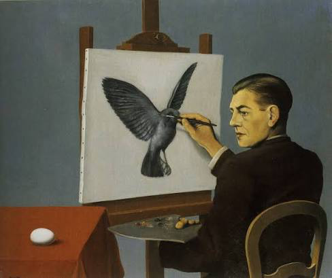
La Clairvoyance
1936 (Rene Magritte)
Magritte had long been interested in the connection between “words” and “images” and had produced a famous 1929 poster with that theme. Hegel lovers might like his “Hegel’s Holidays” better; while Arendtians might prefer Magritte’s “The Human Condition”. My favourite has always been “Clairvoyance” painted in 1936 – not because of the implicit reference to Hegel’s philosophy again, but because it celebrates a talent that I think is the most important talent for a constitutional lawyer: the ability to the “permanent” in the “transient”. A constitutional scholar has to be able to see “behind” everyday legal appearances to discover constitutional essences (and yet these appearances are themselves important as contemporary variations of such essences)! The constitutional scholar’s task is thus that of a “painter of modern life”, that is someone who is not just writing about the philosophical ideas of “justice” or “sovereignty” from an abstract point of view; his or her task, rather, is to describe these eternal ideas in the way they present themselves today in order to also potentially foresee how they might be tomorrow.
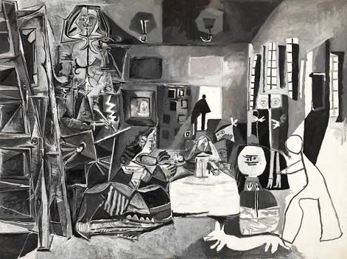
Las Meninas
Conjunto, 1957 (Pablo Picasso)
Picasso was obsessed with “Las Meninas” – the famous Velazquez painting – and produced a whole set of variations of it, which can today be found in Barcelona’s Picasso Museum. Variations are philosophically fascinating, whether in paintings or music or literature, as they achieve something remarkable: while respecting the identity of an original “theme”, which always remains recognisable, they also represent it a completely different style or tradition – here cubism. The great thing about this paining is that very idea of representation is, if you believe Foucault’s “Order of Things”, itself the theme of “Las Meninas”. (The observer is, if you follow the eyes of Velazquez’s self-portrait, deliberately placed where the sitters are supposed to be; and it so seems that you watch a painter painting you – an illusion that is only corrected by the mirror at the back of the room revealing the “real” royal sitters, unless you think that this is a canvas next to the other canvases.) Foucault here famously explored the different ways of “representing” in his “classical” and “modern” episteme, and Picasso’s variation adds a touch of additional modernity – paying respect to the original while cladding it a new style that also resonates with his earlier representation of “Guernica” – a reference within a reference of a reference.
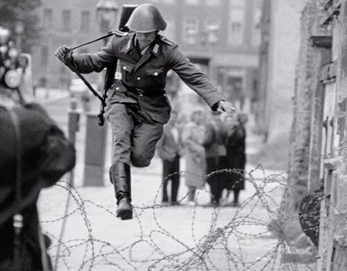
Leap into Freedom
1961 (Peter Leibing)
This photo was taken on 15 August 1961, just two days after the “Berlin Wall” was built that would become part of the “intra-German” border and prevent East-Germans from travelling to the “West” until 1989. The photo shows the nineteen-year-old Konrad Schmuman, who had apparently volunteered to protect the “Wall” as a young officer and who must have realised at the very moment the picture was taken that he would not only be a prison guard for his fellow citizens but for himself too. The photo became one of the iconic images of the Cold War; but it also represents, at an individual level, a moment of ultimate freedom and existential choice – with all that this would bring. (When Schumann returned, after the fall of the Wall, to his hometown in Saxony, his family rejected him, perhaps due to the consequences his decision had on them, and he ultimately committed suicide in 1998.) “Freedom” is a strange thing: it can be negative or positive, republican or something else; but what it means for each of us is, ultimately, a very personal matter but never just a personal matter.